
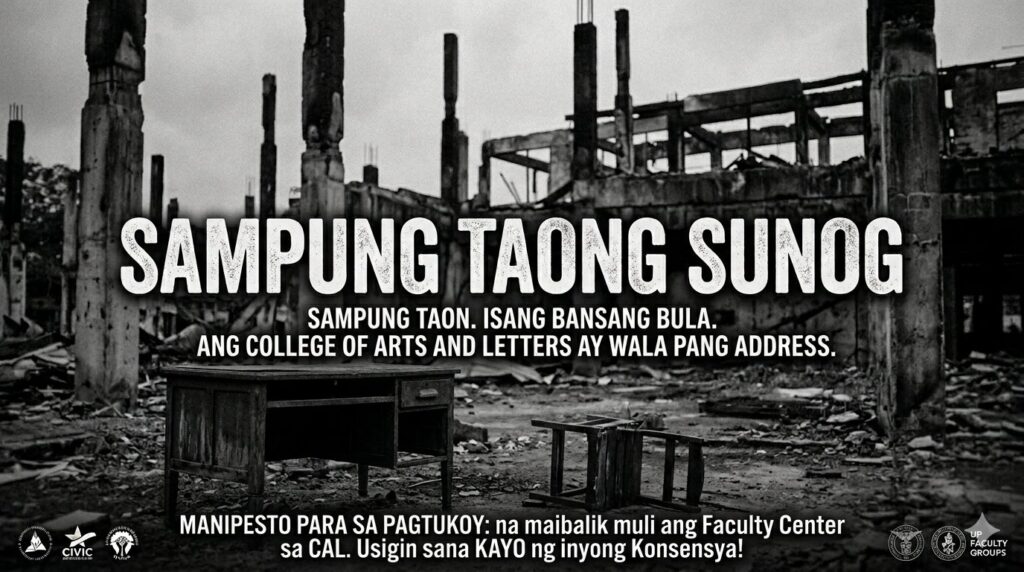
𝐒𝐚𝐦𝐩𝐮𝐧𝐠 𝐓𝐚𝐨𝐧𝐠 𝐒𝐮𝐧𝐨𝐠
On April 1, 2016, the Faculty Center, the home of the UP College of Arts and Letters at the University of the Philippines Diliman burned until the morning light revealed nothing but a skeleton of charred concrete.
For many, the date felt like a cruel irony of the calendar, but the decade that followed has turned the joke into a permanent condition. A university is measured by its endurance, and ten years is a long time—long enough for a freshman to finish a doctoral degree—yet the institution has not laid a single brick to return its scholars to that ground.
𝐓𝐡𝐞 𝐅𝐂 𝐢𝐬 𝐧𝐨 𝐥𝐨𝐧𝐠𝐞𝐫 𝐚 𝐫𝐮𝐢𝐧, 𝐛𝐮𝐭 𝐢𝐭 𝐢𝐬 𝐧𝐨𝐭 𝐚 𝐜𝐨𝐥𝐥𝐞𝐠𝐞. 𝐈𝐭 𝐢𝐬 𝐛𝐞𝐢𝐧𝐠 𝐫𝐞𝐩𝐮𝐫𝐩𝐨𝐬𝐞𝐝 𝐢𝐧𝐭𝐨 𝐚 𝐬𝐮𝐢𝐭𝐞 𝐟𝐨𝐫 𝐭𝐡𝐞 𝐔𝐏 𝐒𝐲𝐬𝐭𝐞𝐦 𝐚𝐧𝐝 𝐃𝐢𝐥𝐢𝐦𝐚𝐧 𝐚𝐝𝐦𝐢𝐧𝐢𝐬𝐭𝐫𝐚𝐭𝐢𝐨𝐧 𝐮𝐧𝐝𝐞𝐫 𝐭𝐡𝐞 𝐠𝐮𝐢𝐬𝐞 𝐨𝐟 𝐚 “𝐅𝐚𝐜𝐮𝐥𝐭𝐲 𝐂𝐨𝐦𝐦𝐨𝐧𝐬”.
There is a cold, bureaucratic clarity in this: the university is building climate-controlled offices for its managers on the same soil where its teachers lost the hand-marked drafts of their life’s work.
In the global ledger of prestige, this displacement remains invisible. On March 25, 2026, the QS World University Rankings by Subject placed the university’s English and Comparative Literature programs in the 151–200 bracket—the highest mark in the country.
Across the broader Arts and Humanities, the university sits at 257th worldwide. These metrics represent the labor of a faculty that anchored the institution’s standing while working out of backpacks.
The data does not record the reality of a world-class teacher, artist and researcher grading papers at the sticky table of a commercial coffee shop or balancing a laptop on their knees in the humid roar of a sidewalk along the UP Diliman Academic Oval.
The professional life of a humanities professor in Diliman has become a nomad’s kit: a drive containing a career’s worth of lectures, a laptop, and a stack of exam papers and teaching materials. This “portable office” was meant to be an emergency measure. After ten years, it has become the default.
The loss of a physical home is a failure of the social mechanics of thought. Intellectual life requires the accidents of the corridor—the unscheduled debate, the mentorship that happens when a student sees a professor’s door ajar, the conversation that turns into a research breakthrough.
By denying the College of Arts and Letters a permanent address, the university has dismantled the physical heart of its academic core. This is the college that teaches every future scientist, doctor, lawyer, and engineer on campus how to think. It has produced eighteen National Artists, yet it remains a tenant without a lease.
To demand “defiant excellence” from a faculty living on the sidewalk for a decade is a policy of diminishing returns. The university frequently trades on the prestige of these rankings to court donors and international partners, yet it prioritizes administrative comfort over the actual production of knowledge.
As Holy Wednesday arrives—falling once again on the anniversary of the fire—the silence from the university’s leadership is the final evidence of a decade of drift. The restoration of the Faculty Center has moved from an urgency to a footnote, an “issue” to be managed rather than a crisis to be solved. A university that claims to be the nation’s conscience cannot ignore its own reflection.
The College of Arts and Letters has delivered the rankings. After ten years of nomadic labor, it should not still be looking for a place to sit down.