
𝗟𝗮𝘁𝗲𝘀𝘁 𝗡𝗲𝘄𝘀
𝐃𝐫. 𝐑𝐚𝐟𝐚𝐞𝐥 “𝐏𝐢𝐩𝐨” 𝐁𝐮𝐧𝐝𝐨𝐜: 𝐓𝐡𝐞 𝐒𝐮𝐫𝐠𝐞𝐨𝐧 𝐨𝐟 𝐒𝐲𝐦𝐦𝐞𝐭𝐫𝐲
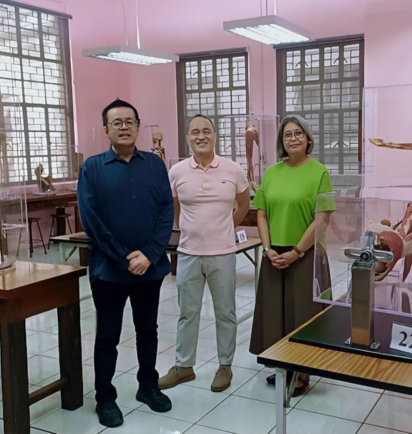
The lights in the Philippine General Hospital operating theater are indifferent to history, but UP College of Arts and Letters (CAL) and UP College of Medicine alumnus Dr. Rafael “Pipo” Bundoc is not. Before him lies a human spine—a complex, architectural stack of bone and nerve—that he views through a dual lens. To the hospital, he is the orthopedic pioneer with a world-class toolkit. To the patient, he is the one who will make them walk again. But to those who know his origins, he is a student of the arts who happens to hold a scalpel.
Long before the prestigious fellowships in Hong Kong, Scotland, and Oxford, Bundoc was a Humanities major under Professor and former National Commission for Culture and the Arts Chairperson Felipe M. De Leon, Jr. at the UP College of Arts and Sciences (CAS, before the Department of Humanities became Art Studies, now a unit under CAL). While his peers in medical school were memorizing the cold Latin of the Gray’s Anatomy textbook, Bundoc was already attuned to the “secret ingredient” of his future career: the pursuit of symmetry. He understood early on that the body is not merely a mechanical assembly, but a masterpiece of form and function. This unconventional foundation transformed surgery from a technical chore into a form of restorative art.
The defining conflict of Bundoc’s career arose not from a lack of skill, but from a mismatch of geography. Upon returning to the Philippines, he encountered a systemic friction: the “one-size-fits-all” medical hardware imported from the West was designed for the larger, heavier frames of Caucasians. For the smaller Filipino anatomy, these implants were often “loud” and ill-fitting.
Drawing on his Scottish training in biomechanics and his humanities-born knack for creative subversion, he began a crusade to “Filipinize” spinal care. In the Integrated Biomechanical Laboratory, he became an inventor out of necessity, developing the country’s first locally produced Continuous Passive Motion (CPM) machine. He was not just fixing bones. He was translating global science into a regional language, ensuring that high-end medicine was not a luxury of the elite or a mismatch for the masses.
His awards, fellowships, and prizes—the TOYM Award for Medicine (1997), the Joseph Trueta Fellowship at Oxford (1998), the recognition as NAST Outstanding Young Scientist (2000), the Metrobank Outstanding Teacher (2005), the Eisenhower Fellowship (2008)—serve as milestones of a life lived at the intersection of disparate worlds. Yet his most enduring “gallery” is the plastination lab, where he preserves anatomical specimens with the care of a museum curator. As UP Full Professor 12 of Anatomy, he teaches his students that a surgeon’s greatest tool is not the drill, but the hand and the eye.
Today, Bundoc remains a rare outlier in a hyper-specialized world. He is a testament to the idea that the most profound scientific breakthroughs often happen when we look through the lens of the arts and humanities. In his hands, the human body is more than a set of fractures to be braced. It is a disordered sculpture waiting for the Surgeon of Symmetry to return it to its original grace.
𝐇𝐚𝐥𝐟 𝐒𝐚𝐢𝐧𝐭𝐬, 𝐚𝐧𝐝 𝐢𝐭𝐬 𝐟𝐨𝐮𝐧𝐝𝐞𝐫𝐬, 𝐔𝐏 𝐂𝐀𝐋 𝐚𝐥𝐮𝐦𝐧𝐚𝐞 𝐂𝐡𝐫𝐢𝐬𝐭𝐢𝐧𝐞 𝐑𝐨𝐪𝐮𝐞 𝐚𝐧𝐝 𝐉𝐨 𝐀𝐫𝐜𝐢𝐚𝐠𝐚
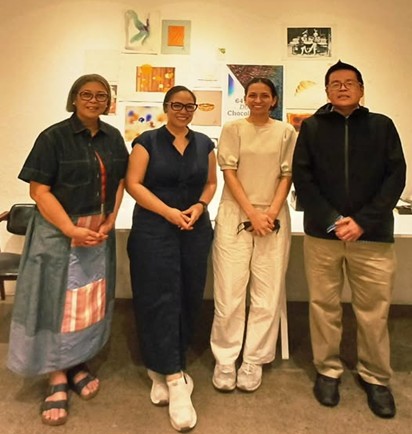
In the taxonomy of Filipino success stories, there is a tendency to favor the explosive—the overnight sensation, the viral disruption, the rapid scale. But the story of Half Saints and its founders, Christine Roque and Jo Arciaga, operates on a different frequency. It is a narrative of slow accumulation, a textured calm that feels less like a business plan and more like a well-constructed sentence. Before the ovens of Sgt. Esguerra or the sleek copper accents of their branch in BGC, there was the UP College of Arts and Letters Faculty Center (FC). Before it was gutted by the fire of 2016, the FC was a labyrinth where the air was heavy with the scent of old paper and the buzz of academic debate. It was here, in the cramped, book-lined cubicles of the UPD Department of European Languages, that Tin and Jo—alumnae of the BA European Languages program and co-founders of UP EURO, a UP CAL-based student organization—foreshadowed their future.
In the FC, Professors Erwin Bautista, Butch Requinta, and Teddy Vera Cruz did not merely teach French as a tool. They taught it as a discipline of the soul. From Erwin Bautista, they absorbed the necessity of structure—the idea that a sentence, like a sauce, collapses if the foundation is rushed. From Butch Requinta, they learned the fluidity of culture—how a language must breathe and adapt to its environment without losing its core identity. And in the lectures of Teddy Vera Cruz, there was the relentless search for 𝑙𝑒 𝑚𝑜𝑡 𝑗𝑢𝑠𝑡𝑒—the exact right word. This linguistic rigor became their psychological 𝑚𝑖𝑠𝑒 𝑒𝑛 𝑝𝑙𝑎𝑐𝑒. When they eventually traded media and corporate systems for the kitchen, they did not leave their liberal arts education behind. They translated it. They understood that you cannot shortcut a language any more than you can shortcut a dark roux. You must inhabit the rules before you can gracefully break them.
When Half Saints opened in 2018 in a corner of Sgt. Esguerra and Mother Ignacia Avenue in Quezon City, it was an exercise in resistance. Friends warned them that the area went dark on weekends, but Tin and Jo saw the shadows as room to grow into their own. They rejected the “safe bet,” opting instead for a menu that felt like a private conversation. Dishes like the Puff Pizza and Chicharron Teriyaki were not designed to trend. They were designed to endure. The true test of this philosophy arrived in 2020. When the pandemic rendered their dining room silent, they faced a choice: compromise or surrender. Rather than forcing their signature risotto into plastic delivery containers where it would lose its integrity, they chose to let it go. They returned to the tactile reality of flour and water. Afternoon Bakes became a testament to their UP-CAL roots—an experimental, weekly “drop” of pastries that prioritized the joy of creation over the certainty of profit. It was a translation exercise, taking the soul of Half Saints and moving it into a new dialect of sourdough and lamination.
Today, the expansion of Half Saints—from Hongo 3-chome (outside the Red Gate of the University of Tokyo) to the cosmopolitan buzz of 5th Avenue in BGC—feels less like a conquest and more like a natural evolution. The BGC menu, featuring the Soft-Shell Crab Risotto with Taba ng talangka and Sea Bass in khao soi curry, reflects a sophisticated Southeast Asian dialogue. Yet, despite the global footprint, the DNA remains rooted in UP CAL. Everything is still made in-house—the condiments, the breads, the cordials. It is a stubborn, beautiful refusal to outsource their soul. Tin and Jo have proven that achievement is not found in the destination, but in the integrity of the gait. They didn’t just build a restaurant group. They built a case study on what happens when you trust the slow, complex, and honest process of becoming yourself. In any language, that is the definition of mastery.
(L) UP CAL Alumni Association Ad Interim Co-Chair Chyn San Juan, UP European Languages alumnae & Half Saints founding owners Christine Roque and Jo Arciaga, and UP CAL Associate Dean for Public Affairs Jose Wendell Capili
𝐏𝐀𝐁𝐀𝐓𝐈𝐃

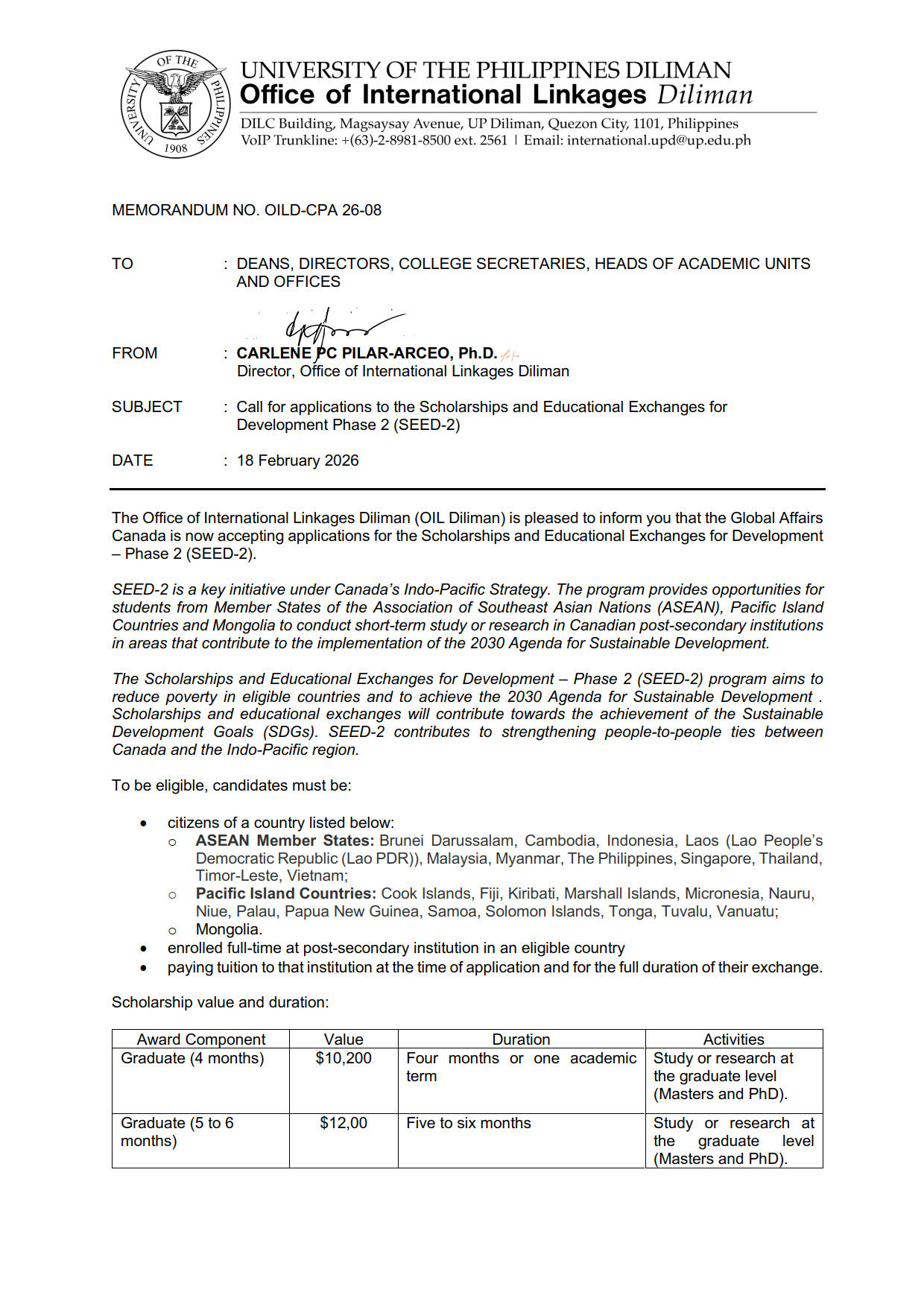

The Office of International Linkages Diliman (OIL Diliman) is pleased to inform you that the Global Affairs Canada is now accepting applications for the Scholarships and Educational Exchanges for Development – Phase 2 (SEED-2).
𝐏𝐀𝐌𝐁𝐀𝐍𝐒𝐀𝐍𝐆 𝐊𝐔𝐌𝐏𝐄𝐑𝐄𝐍𝐒𝐘𝐀𝐍𝐆 𝐓𝐀𝐓𝐒𝐔𝐋𝐎𝐊 𝐒𝐀 𝐏𝐇𝐈𝐋𝐈𝐏𝐏𝐈𝐍𝐄 𝐒𝐓𝐔𝐃𝐈𝐄𝐒 2026
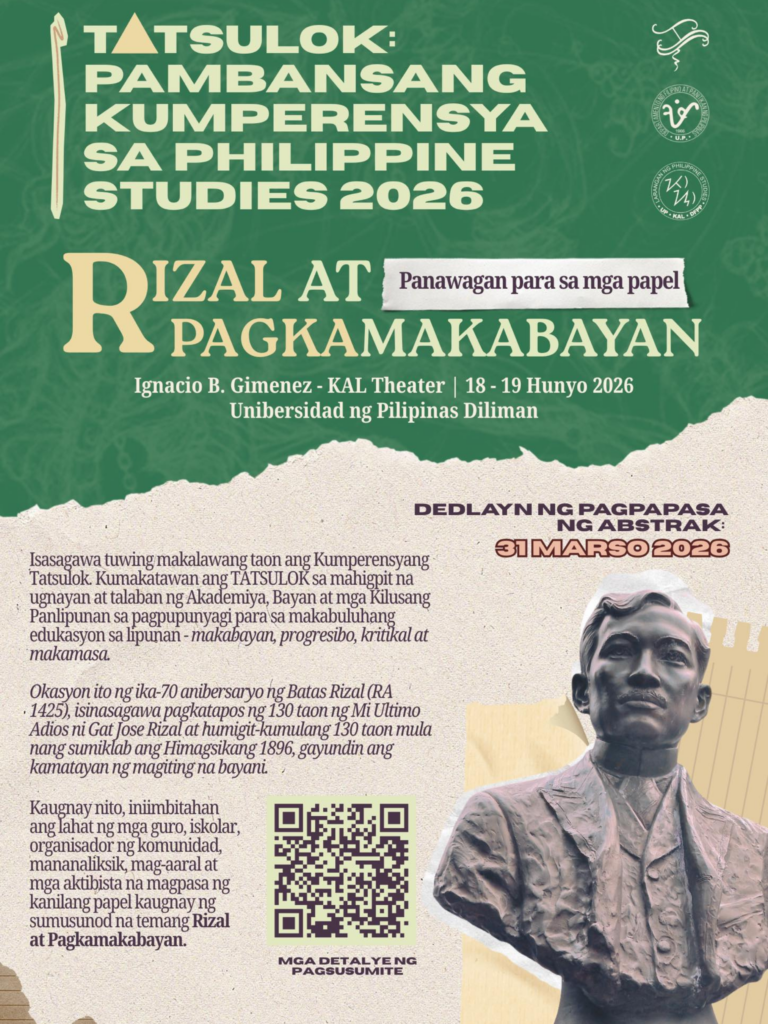
RIZAL AT PAGKAMAKABAYAN
UP DILIMAN Ignacio B. Gimenez-KAL THEATER
18-19 HUNYO 2026
PANAWAGAN PARA SA MGA PAPEL
Inilulunsad ang Pambansang Kumperensiyang Tatsulok ng Philippine Studies 2026 kasabay ng ika-60 taong pagkakatag ng Departamento ng Filipino at Panitikan ng Pilipinas (DFPP) ng Unibersidad ng Pilipinas Diliman. Tatsulok ang kumakatawan sa mahigpit na ugnayan ng Akademya, Bayan at mga Kilusang Panlipunan sa pagpupunyagi para sa makabuluhang edukasyon sa lipunan – makabayan, progresibo, kritikal at makamasa.
Isasagawa tuwing makalawang taon ang Kumperensyang Tatsulok para patuloy na palakasin ang mga nililinang na sub-erya ng Philippine Studies/Araling Pilipino sa DFPP na nakapook sa wika, panitikan at kulturang Pilipino, at may layuning mapatagos sa mga gawain at usaping may saysay sa komunidad, bansa at daigdig. Sa ganitong konteksto, itatampok ang mga paksa at isyung umiinog sa Diskurso at Kapangyarihan, Kilusang Panlipunan, Kulturang Popular, Araling Folklore, at Araling Rizal at Pagkamakabayan.
Ngayong taon, ang tema ng kumperensya ay RIZAL AT PAGKAMAKABAYAN. Okasyon ito ng ika-70 anibersaryo ng Batas Rizal (RA 1425), isinasagawa pagkatapos ng 130 taon ng Mi Ultimo Adios ni Gat Jose Rizal at humigit-kumulang 130 taon mula nang sumiklab ang Himagsikang 1896, gayundin ang kamatayan ng magiting na bayani. Mahabang panahon na ito para tasahin at ipakita ang pag-unlad at mga bagong suliraning kinaharap ng bansa. Umaasang mapag-iibayo ng talastasang ito ang pagpupunyagi ng akademya, mga kilusang panlipunan at ng bayan, para ipagtagumpay at hindi mauwi sa wala ang pag-aalay ng buhay ng ating mga bayani, kasama si Gat Jose Rizal.
Kaugnay nito, iniimbitahan ang lahat ng mga guro, iskolar, organisador ng komunidad, mananaliksik, mag-aaral at mga aktibista na magpasa ng kanilang papel kaugnay ng sumusunod na tema:
RIZAL AT PAGKAMAKABAYAN SA
- Kalagayang Panlipunan sa Kasalukuyan
- Mga Batayang Sektor/ Kaunlarang Pampamayanan/Panlipunan
- Rehiyonal at Pandaigdigang Kalagayan at Suliranin
- Usaping Pangkapangyarihan: Uri, Kasarian, Bayan, Etnisidad
- Mga Kilusang Panlipunan
- Edukasyon at Pedagohiya/Sistemang Pang-edukasyon
- Wika, Panitikan at Malikhaing Pagsulat
- Mga Sining
- Araling Foklor at Pamanang Bayan
- Midya at Kulturang Popular
- Agham,Teknolohiya at Kapaligiran
- Agham Panlipunan
- Politika/Pamamahala/Batas/Pagsasabatas
- Relihiyon/Kilusang Milenaryo
Ipadala ang 300-salitang word file abstrak kalakip ang inyong buong pangalan, institusyong kinabibilangan, email address at maikling bionote (150 salita) sa link na ito: https://tinyurl.com/kumperensyangtatsulok2026. Tumatanggap ng indibidwal at panel submisyon ang Kumperensya.
Marso 31, 2026 ang deadline ng pagpapasa ng abstrak. Ipadadala ang resulta ng inyong aplikasyon mula Abril 20, 2026. Ang mga mapipiling buong papel/gawa ay isasama sa proyektong publikasyon. Itatakda ang hiwalay na dedlayn matapos ang kumperensya. Ang buong papel ay hindi lalampas sa 8,000 salita gamit ang MLA 8th edition pormat. Gaganapin naman ang Kumperensyang Tatsulok sa 18-19 Hunyo 2026.
𝐅𝐫𝐨𝐦 𝐭𝐡𝐞 𝐎𝐟𝐟𝐢𝐜𝐞 𝐨𝐟 𝐈𝐧𝐭𝐞𝐫𝐧𝐚𝐭𝐢𝐨𝐧𝐚𝐥 𝐋𝐢𝐧𝐤𝐚𝐠𝐞𝐬 𝐃𝐢𝐥𝐢𝐦𝐚𝐧 - 𝐎𝐕𝐂𝐀𝐀, 𝐔𝐏 𝐃𝐢𝐥𝐢𝐦𝐚𝐧
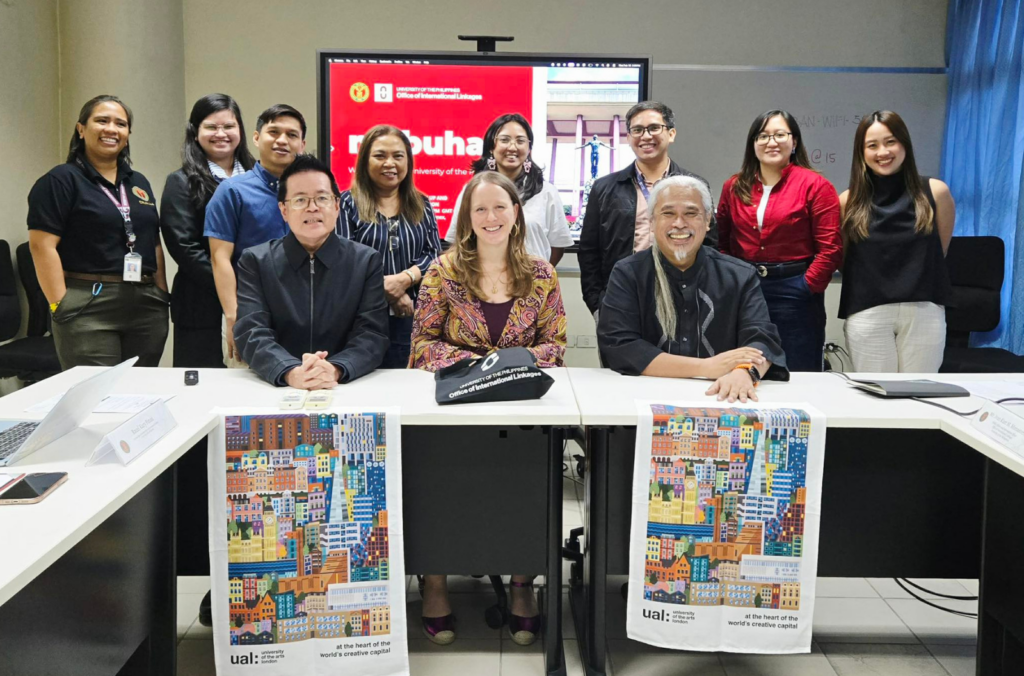
From the Office of International Linkages Diliman – OVCAA, UP Diliman:
The UP College of Arts and Letters participated in an exploratory meeting with the University of Arts London (UAL) at the Institute of Mathematics on Feb. 18.
CAL Associate Dean for Public Affairs Dr. Jose Wendell Capili, Jr., and CAL Coordinator for Internationalization Dr. Ronel Laranjo were present at the meeting organized by the UP Office of International Linkages (OIL) System.
UAL, represented by its Global Partnership and Mobility Head, Ms. Aliya Sorgen, is interested in collaborating with UP Diliman on student mobility and academic exchanges in the Arts, Performance, and Humanities.
Other officials present at the meeting included College of Fine Arts Dean and UP President’s Committee on Culture and the Arts Chair Abdulmari de Leon Imao, Jr.; College of Media and Communication Associate Dean Lucia Tangi; Ms. Andie Jaro, Liaison Officer of the President’s Committee on Culture and the Arts; OIL Diliman Partnership and Communication Section Head Ms. Noelle Rivera; OIL System External Affairs Head Chynna Riego; and British Council officials Mr. Gerald Magno, Ms. Sari Molintas, and Ms. Alyssa Flores.
𝐁𝐫𝐢𝐝𝐠𝐢𝐧𝐠 𝐎𝐜𝐞𝐚𝐧𝐬: 𝐏𝐚𝐧𝐚𝐦𝐚 𝐓𝐚𝐤𝐞𝐬 𝐂𝐞𝐧𝐭𝐞𝐫 𝐒𝐭𝐚𝐠𝐞 𝐢𝐧 "𝐋𝐚𝐭𝐢𝐧𝐨𝐚𝐦𝐞́𝐫𝐢𝐜𝐚 𝐞𝐧 𝐔𝐏" 𝐒𝐞𝐫𝐢𝐞𝐬
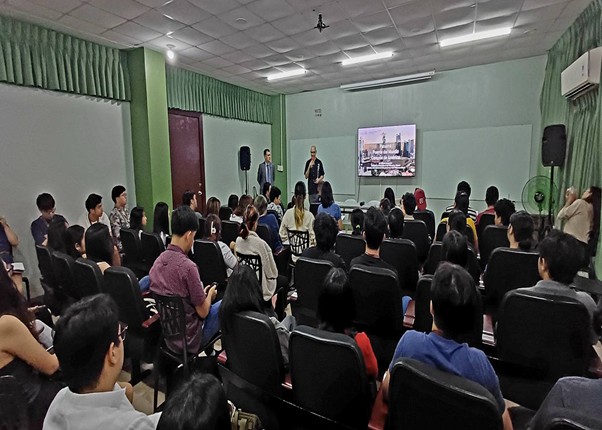
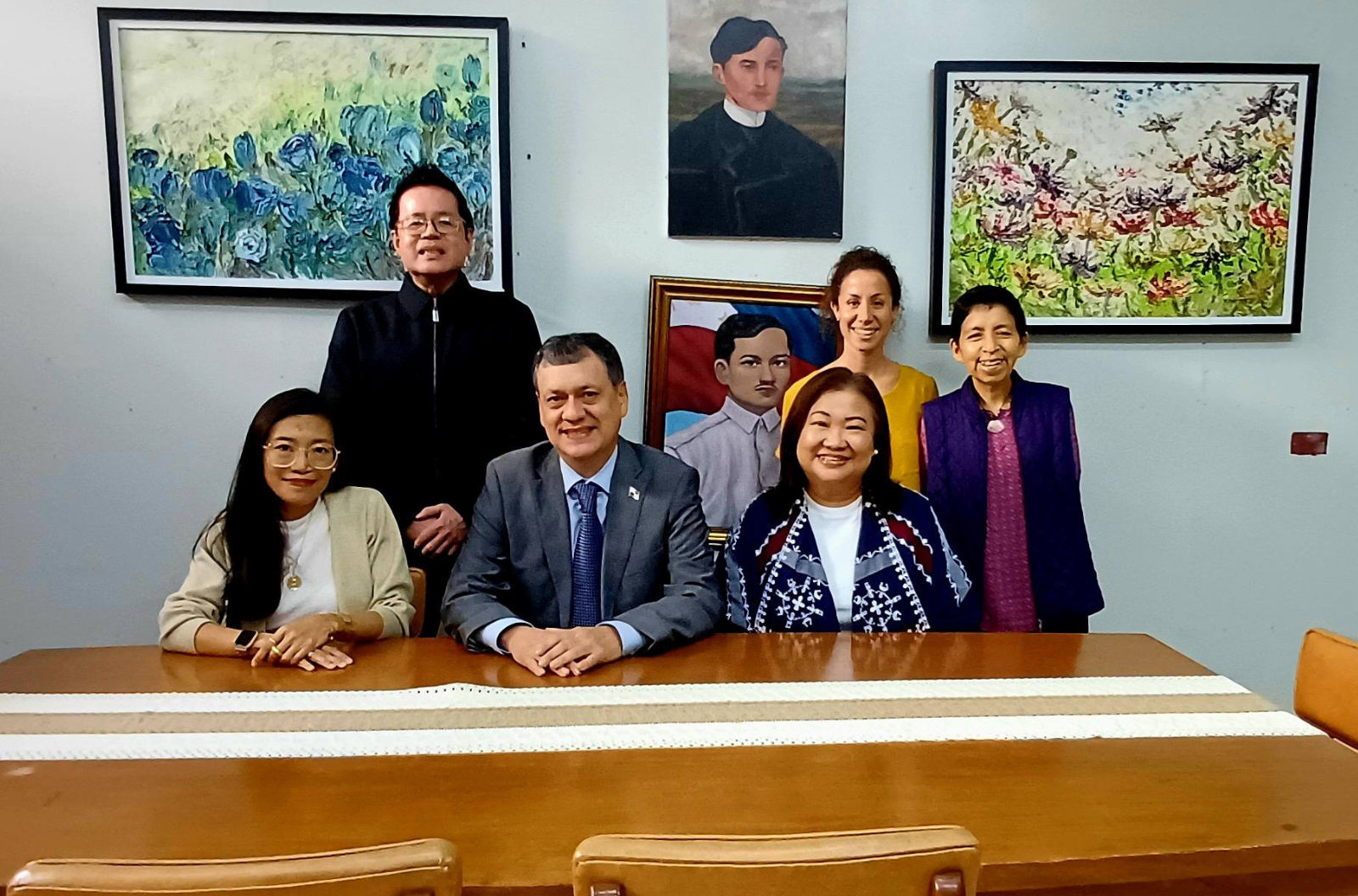
The UP College of Arts and Letters (CAL)-Department of European Languages hosted the latest installment of the “Latinoamérica en UP” series, featuring the heritage of La República de Panamá.
Held on February 18 at the CAL AVR, the event featured His Excellency Eduardo A. Young Virzi, Ambassador of Panama to the Philippines, was the guest of honor. The Ambassador delivered an engaging talk on Panama’s unique position as a global crossroads, its rich history, and the “vibrant cultures” that define the Caribbean, Central, and South America.
The event served as more than just a cultural showcase; it highlighted the growing academic and diplomatic synergy between CAL and the Panamanian Embassy. In a show of institutional support, Dr. Aura Albano Abiera, Associate Dean for Administration, represented CAL Dean Jimmuel Naval.
The delegation from the Department of European Languages (DEL) was led by its Chair, Dr. Anna Sibayan-Sarmiento, emphasizing the department’s commitment to fostering a global perspective among UP students. ”Panama and the Philippines share deep maritime and historical ties. Bringing these stories to the university allows our students to see the world as their campus,” noted Dr. Sibayan-Sarmiento.
Following the Ambassador’s address, the audience—composed of students, faculty, and language enthusiasts—was treated to a Panamanian visual feast. The showcase provided a narrative to the Ambassador’s words, capturing the landscapes and daily life of the “Heart of the Universe.”
The “Latinoamérica en UP” series continues to be a vital platform for cultural exchange, bringing the flavors, languages, and stories of Latin America directly to the Diliman community.
𝐑𝐚𝐧𝐤𝐢𝐧𝐠𝐬 𝐯𝐬. 𝐑𝐞𝐚𝐥𝐢𝐭𝐲: 𝐓𝐡𝐞 𝐒𝐭𝐚𝐭𝐞 𝐨𝐟 𝐭𝐡𝐞 𝐇𝐮𝐦𝐚𝐧𝐢𝐭𝐢𝐞𝐬 𝐚𝐭 𝐔𝐏
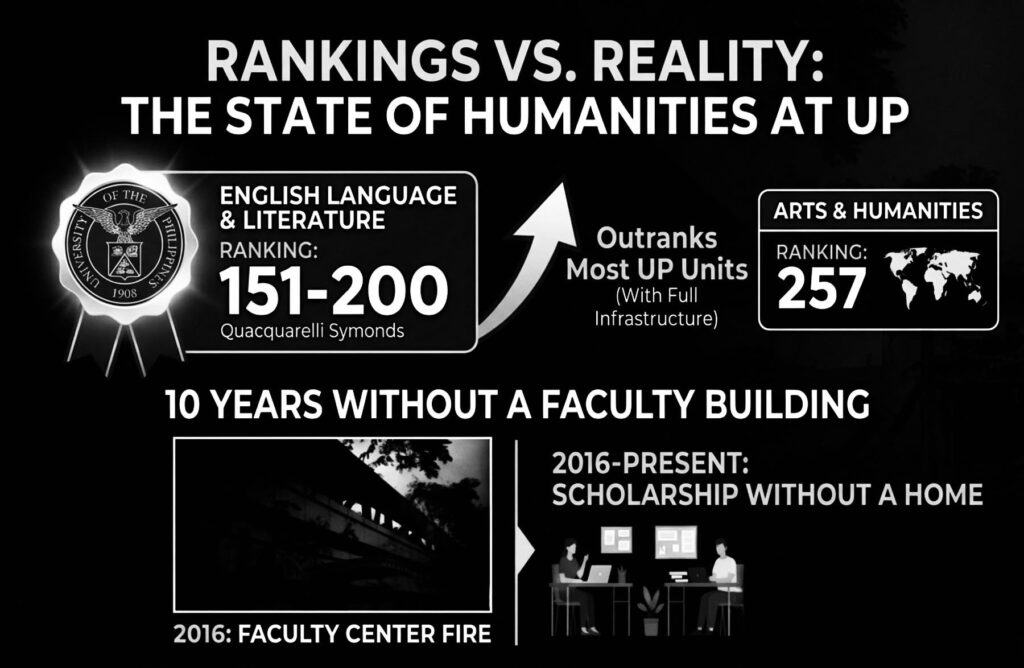
(Based on the QS World University Rankings by Subject, released 25 March 2026)
Ten years ago, a fire destroyed the UP Faculty Center. Since then, the UP College of Arts and Letters has functioned without permanent faculty, staff, and student offices, or dedicated facilities.
Despite this sustained displacement, the latest global rankings place the UPD Department of English and Comparative Literature in the 151–200 bracket—the highest in the Philippines ( https://www.topuniversities.com/…/english-language… ). This performance outranks most other units in the UP system—the majority of which occupy modern, intact infrastructure.
Across the broader Arts and Humanities, the university also maintains its No. 1 domestic ranking, placing 257th worldwide (https://www.topuniversities.com/univer…/arts-humanities… ).
These results were achieved from temporary desks and dismal shared spaces. They confirm that while a building provides necessary support, the intellectual work of the humanities has managed to lead the university even in its absence.
#kalbaryo
𝐂𝐀𝐋, 𝐌𝐚𝐠𝐩𝐚𝐩𝐚𝐭𝐮𝐩𝐚𝐝 𝐧𝐠 𝐅𝐨𝐮𝐫-𝐃𝐚𝐲 𝐖𝐨𝐫𝐤𝐰𝐞𝐞𝐤 𝐚𝐭 𝐌𝐚𝐬 𝐇𝐢𝐠𝐩𝐢𝐭 𝐧𝐚 𝐄𝐧𝐞𝐫𝐠𝐲 𝐂𝐨𝐧𝐬𝐞𝐫𝐯𝐚𝐭𝐢𝐨𝐧 𝐏𝐫𝐨𝐭𝐨𝐜𝐨𝐥𝐬
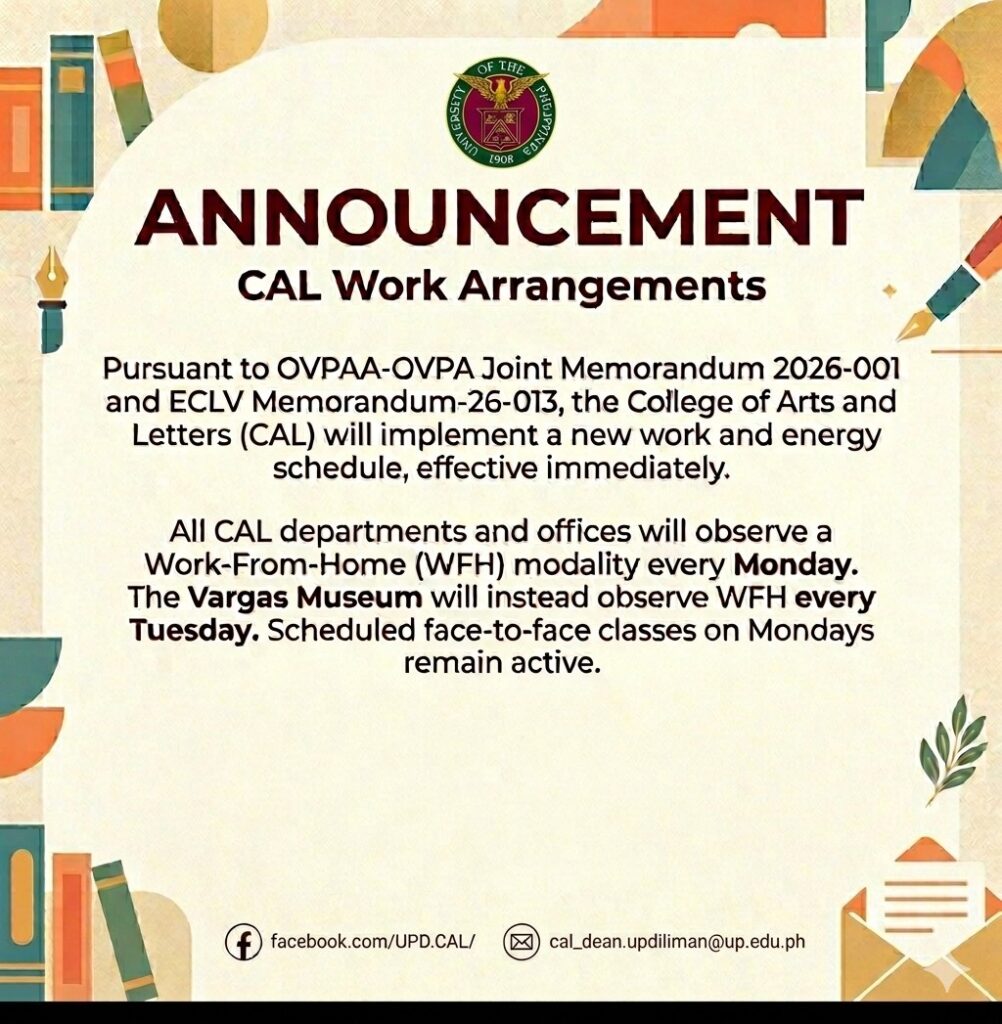
Bilang bahagi ng malawakang inisyatiba ng UP Diliman para sa operational efficiency at sustainability, pormal nang inanunsyo ng UP College of Arts and Letters (CAL) ang paglipat sa four-day workweek simula ngayong Marso 2026. Ang hakbang na ito ay alinsunod sa Memorandum No. ECLV-26-013 at OVPAA-OVPA Joint Memorandum 2026-001.
Sa ilalim ng bagong direktiba, itinakda ang bawat Lunes bilang opisyal na Work-From-Home (WFH) day para sa lahat ng akademikong departamento (Art Studies UP Diliman, UPD Department of English and Comparative Literature, UP Departamento ng Filipino at Panitikan ng Pilipinas, UPD Department of European Languages, at UP Department of Speech Communication and Theatre Arts), administratibong opisina (UPD CAL College Secretary, UPD CAL Graduate Studies Office) at mga yunit sa ilalim ng Kolehiyo (UP College of Arts and Letters Library, Likhaan: University of the Philippines Institute of Creative Writing, at Dulaang Unibersidad ng Pilipinas).
Layunin ng transisyong ito na bawasan ang carbon footprint ng unibersidad habang pinapanatili ang de-kalidad na serbisyong administratibo sa pamamagitan ng mga digital platform.
𝐸𝑠𝑡𝑟𝑎𝑡𝑒ℎ𝑖𝑘𝑜𝑛𝑔 𝐼𝑠𝑘𝑒𝑑𝑦𝑢𝑙 𝑎𝑡 𝐴𝑘𝑎𝑑𝑒𝑚𝑖𝑘𝑜𝑛𝑔 𝑂𝑝𝑒𝑟𝑎𝑠𝑦𝑜𝑛
Nagpakita ng kaunting pagkakaiba ang iskedyul para sa UP Vargas Museum, na mananatiling bukas para sa kanilang regular na on-site na operasyon. Ililipat ang kanilang WFH day sa Martes.
Nilinaw din ng Tanggapan ng Dekano na ang mga face-to-face na klase tuwing Lunes ay hindi maaantala, bagaman binibigyan ng awtonomiya ang mga guro na magtakda ng alternative modalities kung kinakailangan para sa kanilang mga kurso.
Binigyang-diin din sa advisory na sa mga linggong may regular na holiday, mawawala ang WFH privilege. Sa ganitong pagkakataon, ang nasabing holiday ang magsisilbing kapalit ng WFH day, at ang lahat ng kawani ay kailangang mag-ulat nang pisikal sa kani-kanilang mga opisina tuwing 𝐿𝘶𝑛𝘦𝑠.
𝐷𝑖𝑠𝑖𝑝𝑙𝑖𝑛𝑎 𝑠𝑎 𝐸𝑛𝑒𝑟ℎ𝑖𝑦𝑎
Kasabay ng pagbabago sa oras ng paggawa, magpapatupad din ang CAL ng mga teknikal na limitasyon sa paggamit ng kuryente.
Inaasahan ang pakikipagtulungan ng bawat guro, kawani, at mag-aaral upang maging mas matagumpay ang transisyong ito tungo sa isang mas sustainable at responsableng Kolehiyo.
𝙋𝘼𝙈𝘽𝘼𝙉𝙎𝘼𝙉𝙂 𝙆𝙐𝙈𝙋𝙀𝙍𝙀𝙉𝙎𝙔𝘼𝙉𝙂 𝙏𝘼𝙏𝙎𝙐𝙇𝙊𝙆 𝙎𝘼 𝙋𝙃𝙄𝙇𝙄𝙋𝙋𝙄𝙉𝙀 𝙎𝙏𝙐𝘿𝙄𝙀𝙎 2026 𝙍𝙄𝙕𝘼𝙇 𝘼𝙏 𝙋𝘼𝙂𝙆𝘼𝙈𝘼𝙆𝘼𝘽𝘼𝙔𝘼𝙉
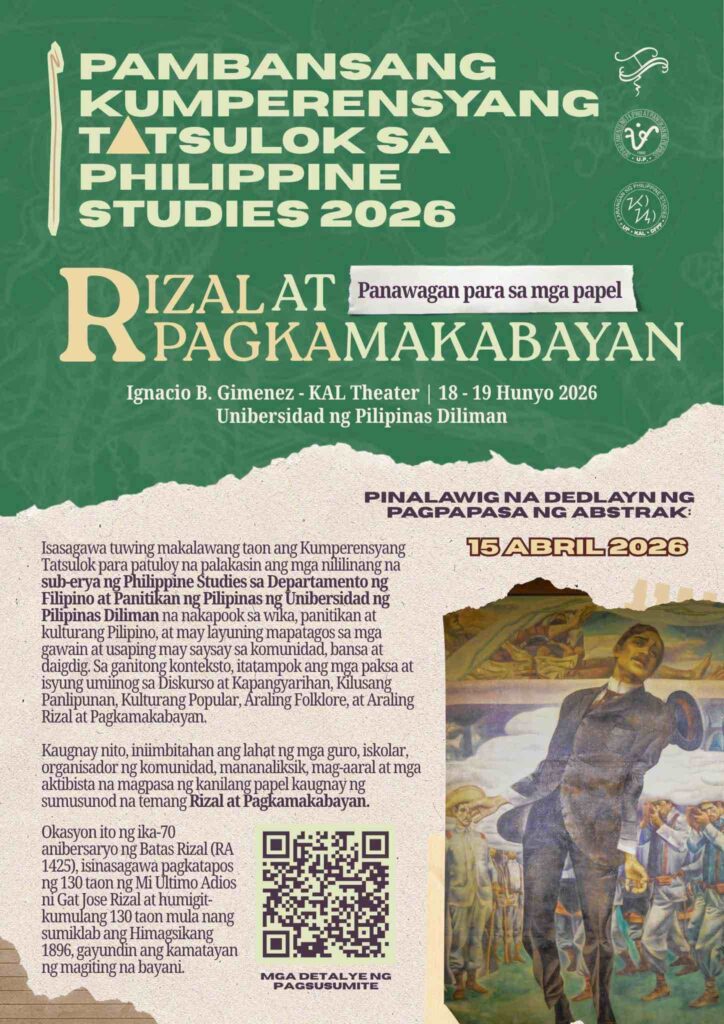
Narinig namin kayo! Para mapagbigyan ng kahilingan ng publikong nais humabol sa kumperensiya, PINALAWIG ANG DEADLINE PARA SA PAGSUSUMITE NG ABSTRAK HANGGANG ABRIL 15!
𝙋𝘼𝙈𝘽𝘼𝙉𝙎𝘼𝙉𝙂 𝙆𝙐𝙈𝙋𝙀𝙍𝙀𝙉𝙎𝙔𝘼𝙉𝙂 𝙏𝘼𝙏𝙎𝙐𝙇𝙊𝙆 𝙎𝘼 𝙋𝙃𝙄𝙇𝙄𝙋𝙋𝙄𝙉𝙀 𝙎𝙏𝙐𝘿𝙄𝙀𝙎 2026
𝙍𝙄𝙕𝘼𝙇 𝘼𝙏 𝙋𝘼𝙂𝙆𝘼𝙈𝘼𝙆𝘼𝘽𝘼𝙔𝘼𝙉
𝙐𝙋 𝘿𝙄𝙇𝙄𝙈𝘼𝙉 𝙄𝙜𝙣𝙖𝙘𝙞𝙤 𝘽. 𝙂𝙞𝙢𝙚𝙣𝙚𝙯-𝙆𝘼𝙇 𝙏𝙃𝙀𝘼𝙏𝙀𝙍
18-19 𝙃𝙐𝙉𝙔𝙊 2026
PANAWAGAN PARA SA MGA PAPEL
Inilulunsad ang Pambansang Kumperensiyang Tatsulok sa Philippine Studies 2026 kasabay ng ika-60 taong pagkakatag ng Departamento ng Filipino at Panitikan ng Pilipinas (DFPP) ng Unibersidad ng Pilipinas Diliman. Tatsulok ang kumakatawan sa mahigpit na ugnayan ng Akademya, Bayan at mga Kilusang Panlipunan sa pagpupunyagi para sa makabuluhang edukasyon sa lipunan – makabayan, progresibo, kritikal at makamasa.
Isasagawa tuwing makalawang taon ang Kumperensyang Tatsulok para patuloy na palakasin ang mga nililinang na sub-erya ng Philippine Studies/Araling Pilipino sa DFPP na nakapook sa wika, panitikan at kulturang Pilipino, at may layuning mapatagos sa mga gawain at usaping may saysay sa komunidad, bansa at daigdig. Sa ganitong konteksto, itatampok ang mga paksa at isyung umiinog sa Diskurso at Kapangyarihan, Kilusang Panlipunan, Kulturang Popular, Araling Folklore, at Araling Rizal at Pagkamakabayan.
Ngayong taon, ang tema ng kumperensya ay RIZAL AT PAGKAMAKABAYAN. Okasyon ito ng ika-70 anibersaryo ng Batas Rizal (RA 1425), isinasagawa pagkatapos ng 130 taon ng Mi Ultimo Adios ni Gat Jose Rizal at humigit-kumulang 130 taon mula nang sumiklab ang Himagsikang 1896, gayundin ang kamatayan ng magiting na bayani. Mahabang panahon na ito para tasahin at ipakita ang pag-unlad at mga bagong suliraning kinaharap ng bansa. Umaasang mapag-iibayo ng talastasang ito ang pagpupunyagi ng akademya, mga kilusang panlipunan at ng bayan, para ipagtagumpay at hindi mauwi sa wala ang pag-aalay ng buhay ng ating mga bayani, kasama si Gat Jose Rizal.
Kaugnay nito, iniimbitahan ang lahat ng mga guro, iskolar, organisador ng komunidad, mananaliksik, mag-aaral at mga aktibista na magpasa ng kanilang papel kaugnay ng sumusunod na tema:
RIZAL AT PAGKAMAKABAYAN SA
● Kalagayang Panlipunan sa Kasalukuyan
● Mga Batayang Sektor/ Kaunlarang Pampamayanan/Panlipunan
● Rehiyonal at Pandaigdigang Kalagayan at Suliranin
● Usaping Pangkapangyarihan: Uri, Kasarian, Bayan, Etnisidad
● Mga Kilusang Panlipunan
● Edukasyon at Pedagohiya/Sistemang Pang-edukasyon
● Wika, Panitikan at Malikhaing Pagsulat
● Mga Sining
● Araling Foklor at Pamanang Bayan
● Midya at Kulturang Popular
● Agham,Teknolohiya at Kapaligiran
● Agham Panlipunan
● Politika/Pamamahala/Batas/Pagsasabatas
● Relihiyon/Kilusang Milenaryo
Ipadala ang 300-salitang word file abstrak kalakip ang inyong buong pangalan, institusyong kinabibilangan,email address at maikling bionote (150 salita) sa link na ito: https://tinyurl.com/kumperensyangtatsulok2026. Tumatanggap ng indibidwal at panel submisyon ang Kumperensya.
Abril 15, 2026 ang pinalawig na deadline ng pagpapasa ng abstrak. Ipadadala ang resulta ng inyong aplikasyon mula Abril 25, 2026. Ang mga mapipiling buong papel/gawa ay isasama sa proyektong publikasyon. Itatakda ang hiwalay na dedlayn matapos ang kumperensya. Ang buong papel ay hindi lalampas sa 8,000 salita gamit ang MLA 8th edition pormat. Gaganapin naman ang Kumperensyang Tatsulok sa 18-19 Hunyo 2026.
𝐁𝐚𝐥𝐚𝐠𝐭𝐚𝐬 𝐚𝐭 𝟐𝟑𝟖
𝐁𝐚𝐥𝐚𝐠𝐭𝐚𝐬 𝐚𝐭 𝟐𝟑𝟖
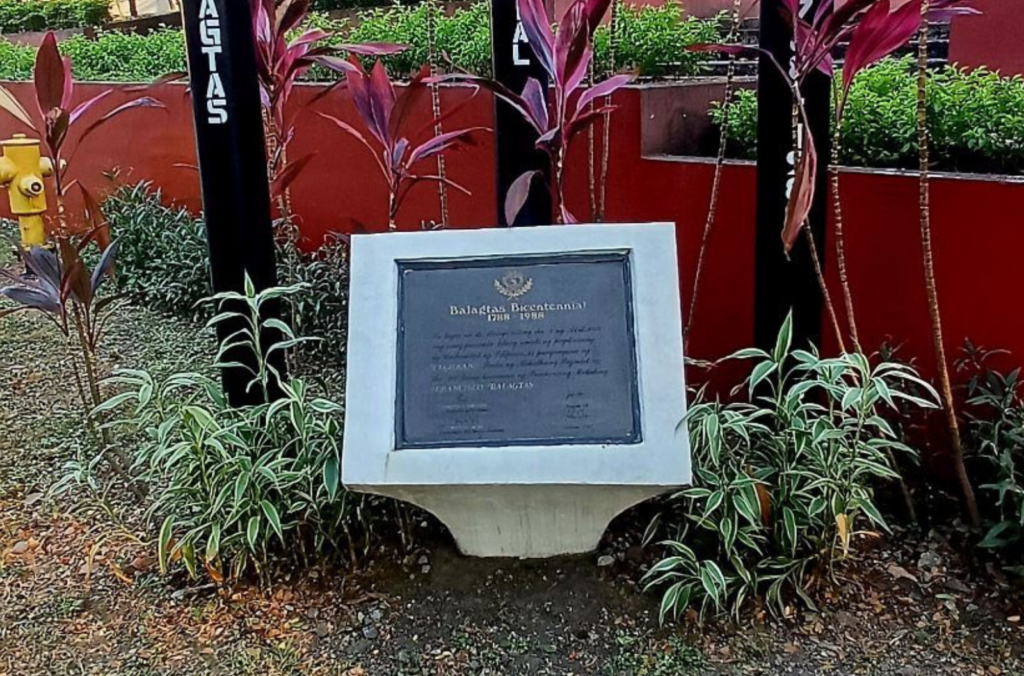
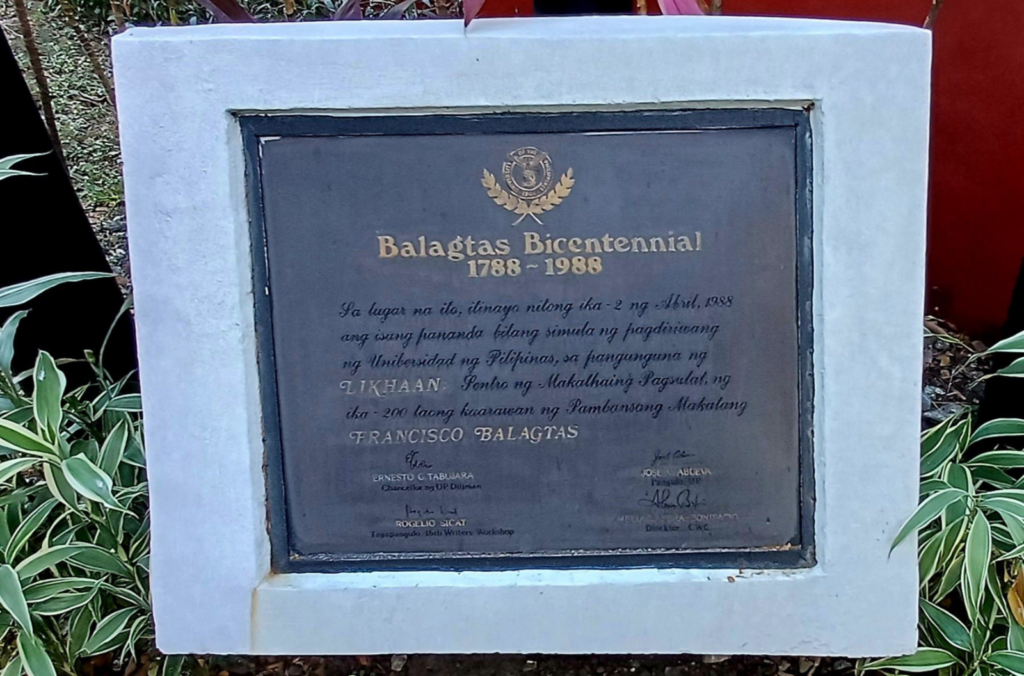
At the corner of Roxas and Roces, near the steps of Palma Hall, a weathered bronze marker sits largely ignored by the morning rush of students. It was bolted into place on April 2, 1988, marking exactly two centuries since the birth of Francisco Balagtas. Today is year 238.
The signatures etched into the metal—Jose V. Abueva, Ernesto Tabujara, Rogelio Sicat, and Amelia Lapeña-Bonifacio—reveal a specific collision of Philippine intellectual life. In 1988, this was not a gathering of bureaucrats, but an alignment of the university’s distinct halves: a political scientist theorizing the modern state, an engineer leading the institution, a novelist of the working class, and a dramatist who gave modern breath to folk tradition.
Why this particular group gathered for a poet who died in 1862 is a matter of lineage.
Balagtas was our most successful smuggler of ideas. Decades before the 1896 Revolution, he repurposed the awit—a rigid, colonial verse form—to map the psychology of oppression in Florante at Laura. He moved from the high-stakes political maneuvers of Orosman at Zafira to the sharp, one-act social critiques of La India Elegante y el Negrito Amante, proving it was possible to speak truth while standing in plain sight of the censor.
By placing this marker at the university’s core, these four leaders recognized that the institution’s mission—whether in the hard sciences, governance, or the arts—is rooted in that same Balagtasan instinct: the necessity of finding a vocabulary for freedom when the official language offers none.
The bronze has oxidized and the signatories have passed into history, but the alignment remains. We do not read Balagtas to sentimentally revisit the past. We read him to decode the persistent mechanics of our present.
𝐔𝐏 𝐂𝐀𝐋 𝐌𝐚𝐫𝐤𝐬 𝐃𝐞𝐜𝐚𝐝𝐞 𝐒𝐢𝐧𝐜𝐞 𝐅𝐚𝐜𝐮𝐥𝐭𝐲 𝐂𝐞𝐧𝐭𝐞𝐫 𝐅𝐢𝐫𝐞 𝐰𝐢𝐭𝐡 𝐏𝐫𝐨𝐭𝐞𝐬𝐭𝐬, 𝐃𝐞𝐦𝐚𝐧𝐝𝐬 𝐟𝐨𝐫 𝐏𝐞𝐫𝐦𝐚𝐧𝐞𝐧𝐭 𝐇𝐨𝐦𝐞
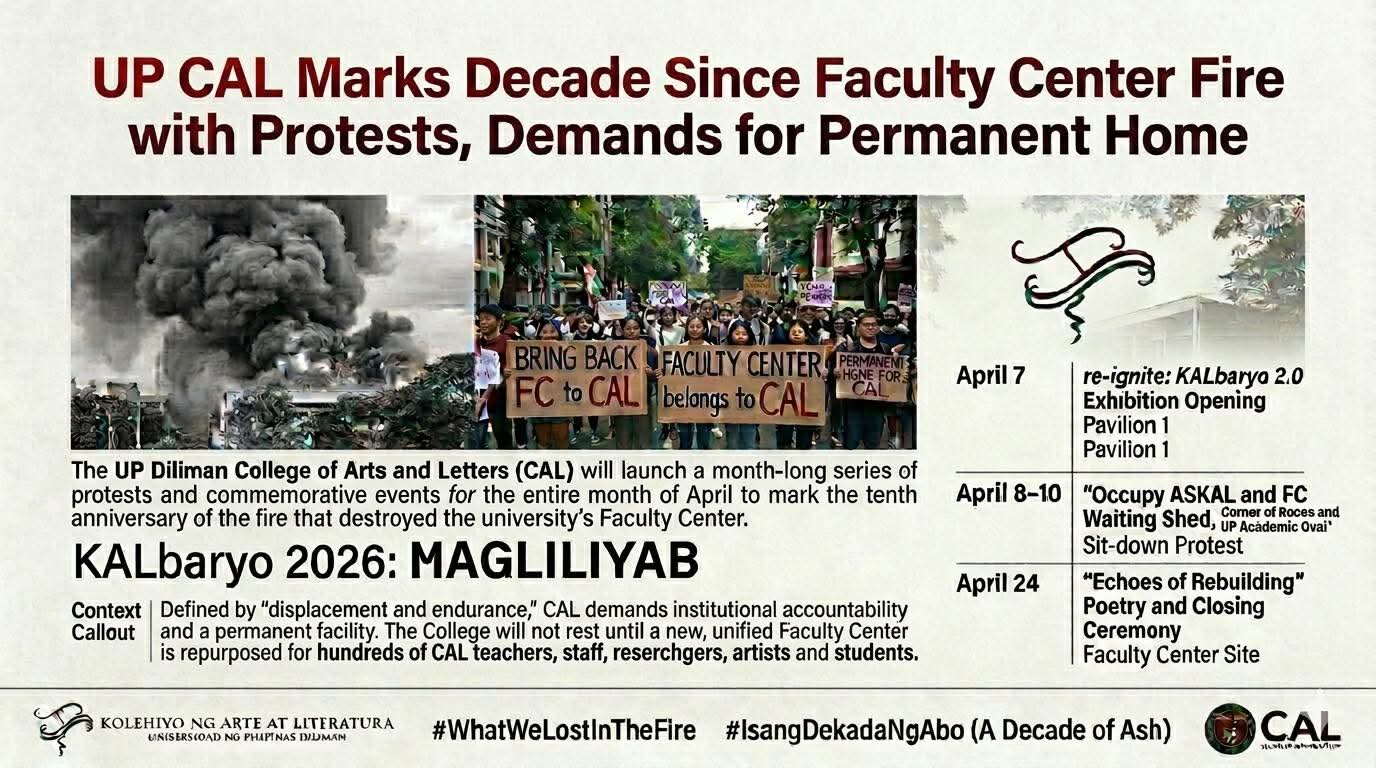
The UP College of Arts and Letters (CAL) will commence a month-long series of protests and commemorative activities throughout April to observe the tenth anniversary of the fire that devastated the university’s Faculty Center.
The program, entitled KALbaryo 2026: MAGLILIYAB, signifies a shift in the college’s perspective from mourning the 2016 catastrophe to advocating for institutional accountability and the establishment of a permanent facility.
In a memorandum issued on March 23, CAL Dean Jimmuel C. Naval stated that the decade since the fire has been characterized by “displacement and endurance.” The Faculty Center, a hub for teaching, research, and creative activities, was consumed by an overnight fire on April 1, 2016, leaving hundreds of faculty members, staff, researchers, artists, and students without office spaces and destroying decades of invaluable scholarly work.
The College of Arts and Letters’ April 2026 calendar includes several significant activities aimed at highlighting the ongoing absence of a dedicated home for the college:
• 𝗔𝗽𝗿𝗶𝗹 𝟳: 𝗧𝗵𝗲 𝗼𝗳𝗳𝗶𝗰𝗶𝗮𝗹 𝗹𝗮𝘂𝗻𝗰𝗵 𝗼𝗳 𝘁𝗵𝗲 ” 𝗿𝗲- 𝗶𝗴𝗻𝗶𝘁𝗲: 𝗞𝗔𝗟𝗯𝗮𝗿𝘆𝗼 𝟮. 𝟮.𝟬 ” 𝗲𝘅𝗵𝗶𝗯𝗶𝘁𝗶𝗼𝗻 𝗮𝘁 𝗣𝗮𝘃𝗶𝗹𝗶𝗼𝗻 𝟭.
• 𝗔𝗽𝗿𝗶𝗹 𝟴–𝟭𝟬: “𝗢𝗰𝗰𝘂𝗽𝘆 𝗔𝗦𝗞𝗔𝗟,” 𝗮 𝘁𝗵𝗿𝗲𝗲- 𝗱𝗮𝘆 𝘀𝗶𝘁- 𝗶𝗻 𝗽𝗿𝗼𝘁𝗲𝘀𝘁 𝘀𝗰𝗵𝗲𝗱𝘂𝗹𝗲𝗱 𝗮𝘁 𝘁𝗵𝗲 𝗶𝗻𝘁𝗲𝗿𝘀𝗲𝗰𝘁𝗶𝗼𝗻 𝗼𝗳 𝗥𝗮𝗰𝗲𝘀 𝗦𝘁𝗿𝗲𝗲𝘁 𝗮𝗻𝗱 𝗥𝗼𝘅𝗮𝘀 𝗔𝘃𝗲𝗻𝘂𝗲 𝗮𝗹𝗼𝗻𝗴 𝘁𝗵𝗲 𝗔𝗰𝗮𝗱𝗲𝗺𝗶𝗰 𝗢𝘃𝗮𝗹.
• 𝗔𝗽𝗿𝗶𝗹 𝟮𝟰: 𝗔 𝗽𝗼𝗲𝘁𝗿𝘆 𝗿𝗲𝗮𝗱𝗶𝗻𝗴 𝗲𝗻𝘁𝗶𝘁𝗹𝗲𝗱 “𝗘𝗰𝗵𝗼𝗲𝘀 𝗼𝗳 𝗥𝗲𝗯𝘂𝗶𝗹𝗱𝗶𝗻𝗴,” 𝗳𝗼𝗹𝗹𝗼𝘄𝗲𝗱 𝗯𝘆 𝘁𝗵𝗲 𝗰𝗹𝗼𝘀𝗶𝗻𝗴 𝗰𝗲𝗿𝗲𝗺𝗼𝗻𝘆 “𝗡𝗮𝘁𝗮𝗽𝗼𝘀 𝗮𝗻𝗴 𝗦𝘂𝗻𝗼𝗴, 𝗡𝗮𝗻𝗮𝘁𝗶𝗹𝗶 𝗮𝗻𝗴 𝗨𝘀𝗼𝗸” (𝗧𝗵𝗲 𝗙𝗶𝗿𝗲 𝗘𝗻𝗱𝗲𝗱, 𝘁𝗵𝗲 𝗦𝗺𝗼𝗸𝗲 𝗥𝗲𝗺𝗮𝗶𝗻𝘀), 𝗮𝘁 𝘁𝗵𝗲 𝗼𝗿𝗶𝗴𝗶𝗻𝗮𝗹 𝗙𝗮𝗰𝘂𝗹𝘁𝘆 𝗖𝗲𝗻𝘁𝗲𝗿 𝘀𝗶𝘁𝗲.
In the decade since the fire, CAL faculty and students have operated from temporary spaces within Palma Hall and various pavilions.
The commemoration aims to reaffirm CAL’s “right to a permanent and dignified home” and to advocate for a more expeditious resolution to the infrastructure deficit.
The month- long mobilization will also feature digital campaigns under the hashtags #WhatWeLostInTheFire and #IsangDekadaNgAbo to document the long- term impact of the Faculty Center fire loss on the state of arts and humanities in the Philippines.